Market Snapshot#
Two targets reported, some profits taken, then the remaining entries back to breakeven. That was the story of Gold Trader Mo's public gold sell sequence on October 8, 2026—not a full target sweep or an uninterrupted winning day. The completed OANDA daily bar dated October 8 closed at $4,133.690 per ounce, a separate reference from the earlier trade updates.
The useful part is what happened between the sell call and the final update: Mo widened the stop, called for partial profit-taking, and then instructed followers to protect the remaining positions. A member also described losing entries alongside earlier gains. The public @GTMO record lets readers follow that progression rather than judge the day from a celebratory screenshot alone.
Want to follow the public updates with that context? Message @GTMOBest for free signal channel access. Read the management updates as carefully as the original call; this October 8 recap is historical, not an invitation to enter an old trade.
| Gold reference | October 8 context |
|---|---|
| Instrument | OANDA XAUUSD, quoted in US dollars per ounce |
| Completed daily-bar close | $4,133.690 |
| Bar date and timeframe | October 8, 2026; 1D |
| Chart observation | October 9, 2026, at 07:22:26 +07:00 |
The close comes from the TradingView OANDA chart. It is the completed broker daily-bar close, not an official gold fixing, a live quote, or a Vietnam calendar-day close. It provides a session reference; it does not tell us where each follower was filled.
Why The Tone Changed So Fast#
The messages moved from uncertainty to excitement and then protection. At 08:18 UTC, Mo said the trade was floating in the sell zone and reminded followers to manage risk. At 08:28 UTC, he described positions alternating between gains and losses. Those updates are a more honest starting point than pretending the sell worked smoothly from the first moment.
The difficult decision came first. Mo's 08:25:47 UTC stop update moved the stop from 4,135 to 4,137. For a sell position, that was widening the stop, not tightening it. With the same position size, it allowed a larger adverse move before the planned stop. The later protection instruction should not erase that earlier increase in exposure.
By 08:33:20 UTC, the message had changed to taking some profits from the lower entries. At 08:39:53 UTC, Mo reported the first target and instructed followers to move remaining positions to breakeven. Then came the two-target summary and, eventually, the report that the last entries had reached breakeven.
That is why October 8 is worth reading: the public conversation did not end at the most exciting moment. It also recorded when the remaining trade stopped paying. For a different kind of adaptation, the October 7 loss-and-rebound recap provides useful context without turning either session into a promise about the next one.
Technical Outlook#
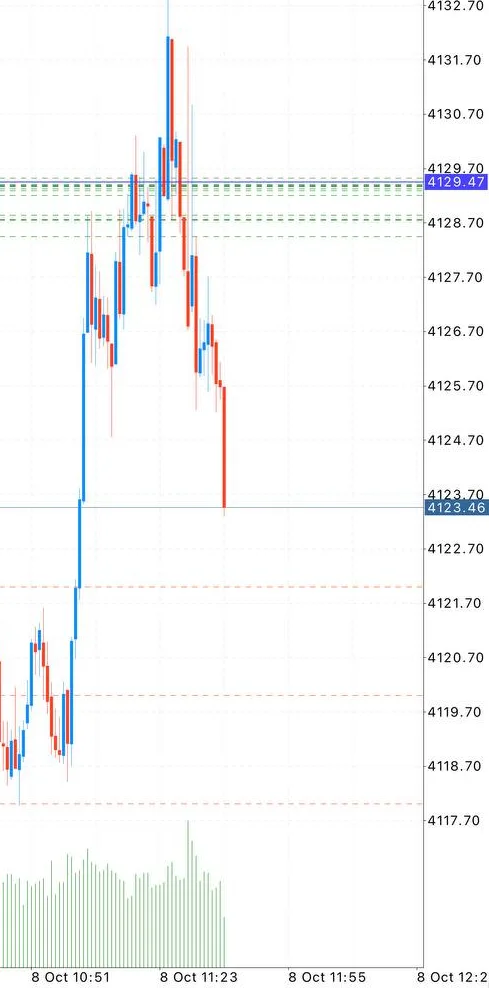
The public sell plan covered 4,126.4–4,131, with an initial stop at 4,135 and staged targets at 4,124, 4,122, 4,120 and 4,118, followed by an open-ended final target. These were the prices in the historical plan, not newly recommended levels.
Mo's later two-target report corresponds to the first two listed targets, 4,124 and 4,122. It does not establish that the lower planned targets were reached. The remaining entries subsequently returning to breakeven is the important limit on the continuation story.
The OANDA daily-bar close at 4,133.690 was above the original sell zone. That leaves a useful distinction: an earlier sell can produce reported target progress without gold finishing the broker session below that entry zone. A closing reference is not a substitute for the timing of a shorter trade, and a short-lived move is not proof of a lasting downtrend.
For readers looking ahead, the practical question is whether a fresh setup has fresh confirmation—not whether yesterday's prices can simply be reused. The October 6 report on two public buy sequences offers a contrasting directional example. A recurring habit of monitoring risk matters more than carrying yesterday's buy or sell bias into every session.
Trading Signals#
One public sell setup, followed through to its final update#
The initial “Gold sell now” alert at 08:06:56 UTC and the detailed plan at 08:08:32 UTC belong to the same public sequence. They are not two separate trades. The table below follows that one setup; all times are UTC on October 8.
| Time | Public update | What it tells readers |
|---|---|---|
| 08:06:56 | Initial sell alert | The direction was announced before the later outcome messages. |
| 08:08:32 | Sell zone and plan | Zone 4,126.4–4,131; initial stop 4,135; staged targets below the zone. |
| 08:25:47 | Stop moved to 4,137 | A wider stop, not reduced risk at unchanged size. |
| 08:33:20 | Partial profit-taking instruction | Mo asked followers to take some profits from the lower entries. |
| 08:39:53 | First target and breakeven instruction | First target reported; remaining positions were to be protected at their entry prices. |
| 08:46:57 | Two-target summary | Mo reported only two targets and said profits had already been closed. |
| 09:04:59 | Remaining entries at breakeven | The final public update did not report a full target sweep. |
Why later shared updates are not another public entry#
At 11:11:59 UTC, Mo explicitly told the public audience not to enter the later trade because it was already at breakeven. Subsequent shared updates should be read with that warning, not counted as another fresh public signal to copy. This recap does not reconstruct a second public entry from those delayed messages.
Signal Performance Breakdown#
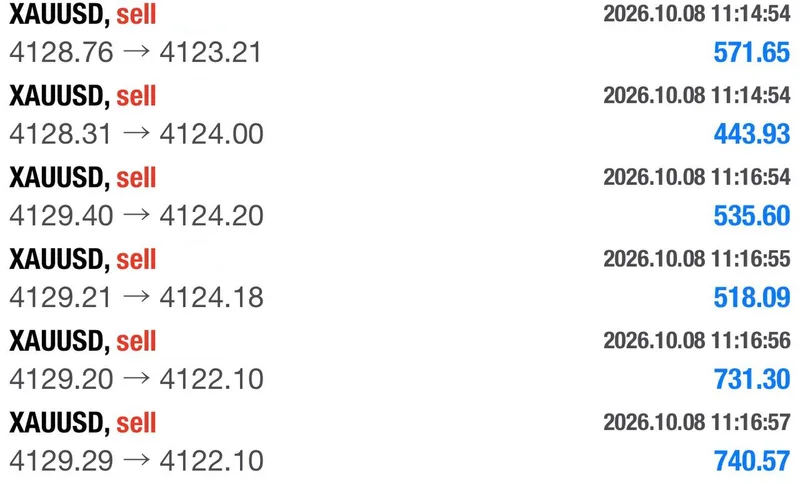
The strongest supported outcome is precise: Mo reported two targets, said partial profits had been closed, and later reported the last entries at breakeven. The public messages document what he said and when. They are not an independently audited execution history, a verified account return, or proof that every follower achieved the same result.
Nor should “breakeven” be read as guaranteed zero risk. An instruction to move a stop to an entry price is different from confirmation that every follower changed an order in time. Spreads, fees, slippage and execution differences can still affect the result.
Member feedback included both gains and losses#
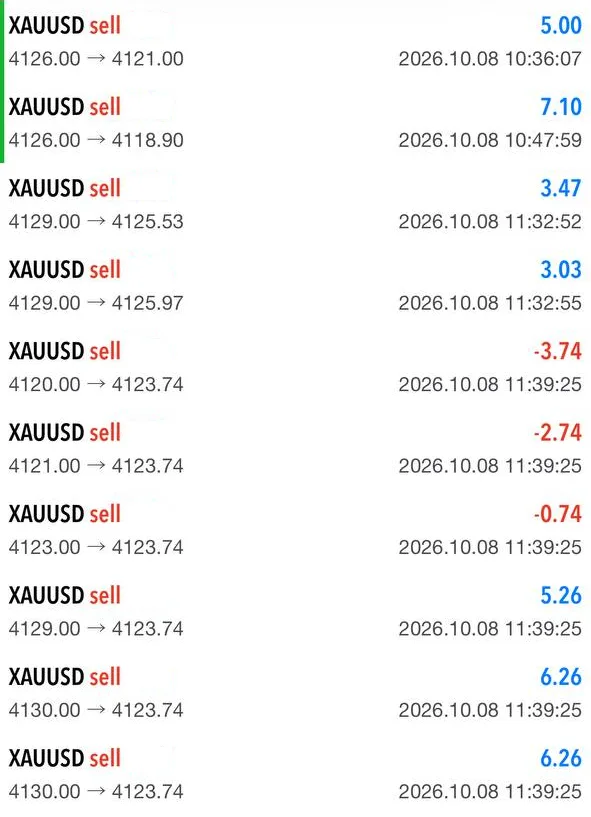
The same-day feedback was not uniformly positive. Simon's espresso-themed response celebrated profits. Another member's message said they had three losing entries, had already made gains, and closed because they were satisfied.
That second account belongs beside the celebration, not outside it. Three losing entries in a member's account are not evidence of three failed Mo signals. Equally, earlier gains do not make the losing entries disappear. The member's description is a personal report, not a verified net-profit calculation or a result to expect from following the channel.
Mo also shared a trading screenshot with his two-target statement. Read it alongside that statement rather than infer a daily earnings total from individual rows. The clearest reason to follow this sequence is the visible management conversation, including its limits—not an unsupported winning percentage.
Execution Lessons#
An adjustment is not automatically a reduction in risk. Moving a sell stop farther above the entry gives the trade more room, but it also increases the adverse price distance at unchanged size. Followers need to understand that cost before treating a new stop as “better.”
Partial profit-taking and the remaining position are different decisions. The October 8 messages separated taking some gains from deciding what to do with exposure still open. When the remaining entries later reached breakeven, that did not undo profits Mo had already reported closing. It also did not turn the remaining positions into additional target winners.
Read the last update, not just the best screenshot. The two-target summary and final breakeven message tell a more complete story together. For a contrasting target progression, see the October 5 staged-target recap; its different outcome should not be imported into October 8.
Being late can change the decision entirely. A shared update from a trade already under protection is not necessarily an actionable entry. Here, the public warning was explicit. Not entering was part of the message, not a detail to skip.
What The Day Means Going Forward#
October 8 makes a grounded case for following Mo's updates: readers could see the original plan, the uncomfortable adjustment, the request to take some profits, and the point where the remaining trade ended at breakeven. That is more useful than a headline claiming that everything won.
The lesson to carry forward is a reading habit, not a price forecast. Check whether a post is a fresh setup, a management instruction, or a recap. Look for what has changed in exposure and what the author says about the remaining position. Keep member feedback in context, especially when gains and losses appear together.
If you want to follow that conversation rather than arrive after the outcome, ask @GTMOBest about free signal channel access. Use the public @GTMO channel to read the full sequence, including cautions and final updates. Access is a way to follow information; it is not a guarantee of trading success.
FAQ#
How many public setups does this recap cover?#
One fully specified public sell setup. The initial alert and detailed plan are parts of that same sequence. Later shared updates came with an explicit warning not to enter and are not counted as a new public entry.
Did all the planned targets get hit?#
Mo reported only two targets, corresponding to 4,124 and 4,122 in the original plan. He later said the last entries hit breakeven. This report does not claim completion of the lower planned targets.
Was the stop tightened from 4,135 to 4,137?#
No. For a sell position, moving the stop higher widened it. The later move to breakeven was a separate protection instruction.
Did every member finish with a profit?#
The public feedback does not establish that. One member described three losing entries alongside earlier gains. Neither individual feedback nor an author-shared screenshot proves a uniform result across followers.
What does the $4,133.690 close represent?#
The completed OANDA XAUUSD daily bar dated October 8, observed on October 9 at 07:22:26 +07:00. It is not a live quote, official fixing, or confirmation of the prices at which followers traded.
Connect with Gold Trader Mo#
Follow Gold Trader Mo for gold commentary and session recaps, and message @GTMOBest for free signal channel access. Start with the public October 8 plan, then read its updates through the final breakeven message. The value is understanding the decisions as a sequence—not borrowing yesterday's trade after it has ended.
Risk disclaimer: This report is educational commentary, not financial advice or a current trading instruction. Trading involves risk and capital can be lost. Target reports, screenshots and member feedback do not guarantee execution or future results. Past performance is not a reliable indicator of future performance.