
Last Week's Gold Market Recap#
Gold entered the March 23-27 week trying to recover from the violent March 16-20 collapse, but the market never fully escaped correction mode. XAUUSD traded through an enormous $4,295 to $4,584 intraweek range and still finished around $4,417.45, which is a useful reminder that volatility alone is not recovery. The bounce from the lows proved there was still dip demand, but the weekly close proved buyers could not yet convert that demand into sustained control.
That context matters because the prior week had already reset the entire tone of the first quarter. The March 16-20 selloff knocked gold down 10.4% from the $5,000+ zone to roughly $4,491, ending the euphoric phase of the rally and forcing traders to price a correction instead of a breakout. Last week was therefore less about whether gold could rally intraday and more about whether price could reclaim enough overhead territory to convince the market the worst of the liquidation was over.
The answer, for now, is no. Sellers kept reappearing into recovery attempts, especially as price approached the first heavy resistance band above spot. The market could stretch higher inside the week, but it could not hold those gains into Friday's close. That is classic correction behavior: sharp rebounds, heavy overhead supply, and a closing tape that still belongs to caution rather than conviction.
Macro conditions did not help the recovery effort. The DXY stayed around 99-100, the US 10-year Treasury yield hovered near 4.3-4.4%, and that combination kept real-rate pressure on a metal that had just come out of a highly crowded upside move. Gold was not facing a collapse in long-term demand, but it was facing a market that suddenly cared much more about yield competition, dollar resilience, and whether the post-crash floor had actually been earned.
Even so, the larger backdrop has not disappeared. Gold is still up year to date. Central-bank demand is still a structural tailwind. Major institutions remain decisively bullish on the longer horizon. For traders following our broader market analysis coverage, the important shift is not that the long-term bull thesis broke. The shift is that price now has to rebuild trust after a historic drawdown instead of assuming momentum will do that work automatically.
That is why this week's setup is so important. The recovery from $4,295 showed that buyers still exist. The close near $4,417.45 showed they have not yet taken command. Traders who followed our daily reports and last week's weekly forecast saw the same message in real time: gold has stabilized enough to trade levels again, but it has not stabilized enough to declare the correction finished.
For traders who follow Gold Trader Mo, last week should be read as a market in damage assessment, not one in clean trend continuation. The correction is alive, the floor is not yet confirmed, and the coming data calendar gives the market a credible reason to decide whether the next move is a range rotation higher or another leg lower.
Key Fundamental Drivers for Gold This Week#
This week is about whether labor-market data and Fed communication reinforce the higher-for-longer narrative or finally give gold room to breathe. After a crash and partial rebound, the market does not need a dramatic headline to move. It only needs confirmation that the Fed still has reason to stay restrictive, or evidence that growth and employment are cooling enough to soften that stance.
The first major event is Fed Chair Powell's public appearance on Monday, March 30 at 10:30 ET. That matters because it is one of the first high-visibility opportunities for Powell to shape expectations after the blackout period. If his tone leans firmly toward patience on rate cuts, yields can stay elevated and gold may struggle to extend above near-term resistance. If he sounds more balanced and data-dependent, that could give the metal room to hold above immediate support while traders wait for the heavier labor releases later in the week.
Tuesday brings JOLTS Job Openings at 10:00 ET, covering January data. JOLTS is not always the week's main catalyst, but in the current environment it matters because the market is trying to gauge whether labor demand is still too firm for the Fed to relax. A softer print would support the argument that the employment backdrop is cooling in stages. A hotter number would reinforce the idea that labor resilience can keep policy restrictive for longer.
Wednesday's ISM Manufacturing PMI for March is the next critical checkpoint. Manufacturing surveys frequently matter for gold because they help set the tone for the dollar, yields, and broader risk sentiment. If ISM shows fresh weakness, the market may interpret that as another sign that growth is losing momentum after a hard first-quarter move in rates. If ISM surprises higher, it could encourage the view that the economy is absorbing tighter policy better than expected, which is usually a headwind for gold.
Thursday then shifts focus back to employment through Weekly Initial Jobless Claims and ADP Employment Change. Neither release is a perfect predictor of Friday's payrolls report, but both can shape positioning into the weekend's biggest catalyst. In a market as unstable as this one, traders will use Thursday less as a final answer and more as a filter for whether Friday risk should be approached from a defensive or opportunistic posture.
The defining event is Friday's US Employment Situation at 08:30 ET. This is the week's biggest release by a wide margin. Nonfarm payrolls, the unemployment rate, and the broader labor narrative can quickly reset rate expectations, dollar direction, and gold's correction path. A cooler report can revive the argument that the Fed is getting closer to flexibility, which would help gold defend support and challenge higher resistance. A stronger report can keep yields firm and put the market right back into retest mode near the lower end of the range.
There is also an institutional layer behind the macro calendar. J.P. Morgan still has a $6,300 year-end target, Bank of America is at $6,000, and Wells Fargo remains in the $6,100-$6,300 range. Those are not short-term trading signals, but they matter because they frame the correction differently from a structural breakdown. Add persistent central-bank buying and the broader thesis becomes clearer: the long-term bid is intact, but short-term price discovery is now being controlled by macro timing, not by pure momentum.
That leaves the dollar and bond market as the key transmission channels. As long as the DXY stays near 99-100 and the 10-year yield remains around 4.3-4.4%, gold has to work harder to sustain rebounds. A softer jobs narrative can weaken that pressure. A firmer jobs narrative can renew it. The data do not need to be extreme; they only need to tell the market whether the Fed has less reason or more reason to stay restrictive after March's correction.
Gold Technical Analysis & Key Levels#
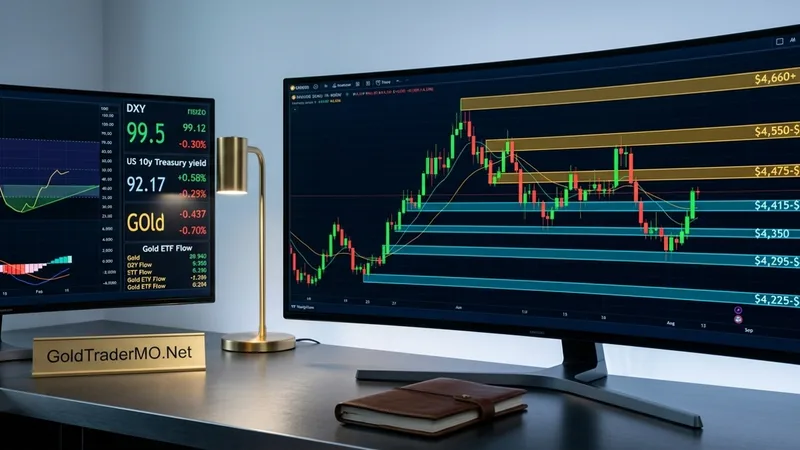
Technically, gold is still trading as a market in correction rather than a market in full recovery. The most important change since the March 16-20 crash is that rebounds are now being judged against damaged structure. The market is no longer asking whether price can bounce. It is asking whether price can reclaim key resistance, hold above it, and prove that the correction has shifted from active risk to controlled consolidation.
The first clue is momentum. RSI is recovering from oversold conditions but is not yet back to neutral, which fits the current tape well. Oversold momentum was relieved by the rebound off $4,295, but that rebound has not gone far enough to reset the chart into a healthier uptrend structure. In other words, gold has improved from panic conditions, but it has not repaired the technical damage left behind by the crash.
The closing level also matters. With gold ending last week near $4,417.45, the market is sitting almost exactly on top of its first immediate support band. That gives the opening sessions an unusually clear job: defend the pivot and build, or lose it and force a deeper retest. Because gold is still digesting a major liquidation phase, traders should think in zones rather than single-price precision.
The level map for this week is straightforward:
| Zone | Price Area | Why It Matters |
|---|---|---|
| Immediate support | $4,415-$4,420 | Closing-area pivot. Holding this band keeps the recovery attempt alive early in the week. |
| Secondary support | $4,350 | First meaningful line below the current pivot. Losing it would show the market is rotating back into defensive mode. |
| Prior low support | $4,295-$4,300 | Last week's floor and the most obvious retest target if the correction deepens. |
| Structural support | $4,225-$4,250 | Deeper demand zone that would likely attract stronger medium-term interest if reached. |
| Immediate resistance | $4,475-$4,500 | First recovery gate. Bulls need acceptance above this area to improve short-term structure. |
| Major resistance | $4,550-$4,584 | Prior week recovery ceiling and the key band that separates rebound noise from a stronger reversal attempt. |
| Broader recovery gate | $4,660+ | A reclaim here would materially change the technical conversation and signal a stronger recovery campaign. |
What makes this map especially useful is how cleanly it lines up with the correction narrative. If buyers can defend $4,415-$4,420 and push back through $4,475-$4,500, the market can start building a case for another attack on $4,550-$4,584. If price instead slips under $4,350, then the recovery attempt starts to look incomplete and the path back to $4,295-$4,300 opens quickly.
From a market-structure perspective, $4,550-$4,584 is the real test. That zone capped the prior recovery attempt and remains the most important overhead resistance of the week. A clean reclaim would tell traders that dip buyers are not just defending lows; they are absorbing supply aggressively enough to shift the short-term balance. Failing there again would keep gold trapped in a correction regime and reinforce the idea that rallies are still being sold.
There is also a practical execution angle. Traders do not need to predict the full weekly direction from the Monday open. They need to know where confirmation exists. That is why the technical roadmap matters more than broad emotion right now. The best setups this week will likely come from reactions at these zones, not from assuming the correction is already over or from assuming every bounce must fail.
For traders who want a tighter framework for intraday execution, our gold scalping strategy guide remains relevant in exactly this kind of tape. The market is volatile, level-sensitive, and headline-dependent, which means confirmation and invalidation are far more useful than static directional conviction.
Risk Events & Economic Calendar#
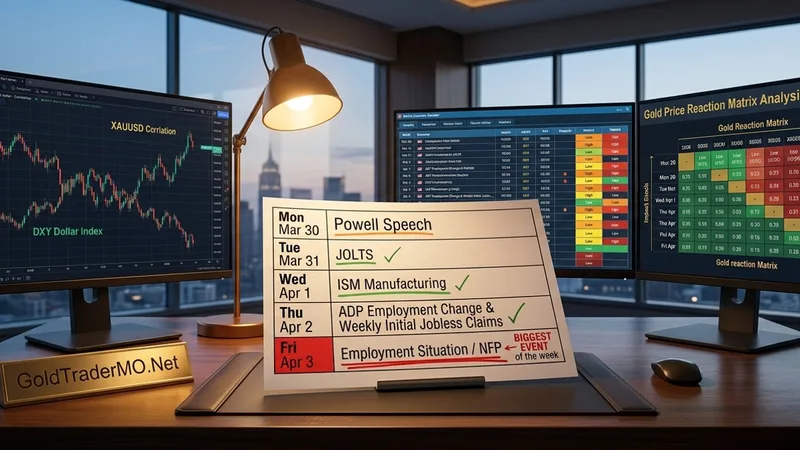
This week's economic calendar is compact, clear, and unusually important because every major event feeds directly into the same question: is the labor backdrop soft enough to reduce Fed pressure, or strong enough to keep gold trapped in correction mode? The confirmed schedule is below.
| Day | Event | Impact Focus | Gold Implication |
|---|---|---|---|
| Monday, March 30 | Powell appearance at 10:30 ET | First major Fed signal after blackout | A balanced tone can support gold stabilization; a firm higher-for-longer message can cap rebounds quickly. |
| Tuesday, March 31 | JOLTS Job Openings at 10:00 ET | Labor demand and hiring resilience | Softer openings can help gold hold support; stronger openings can keep yields and the dollar firm. |
| Wednesday, April 1 | ISM Manufacturing PMI | Growth, activity, and macro tone | Weak manufacturing data can help the recovery case; stronger data can pressure gold through the rates channel. |
| Thursday, April 2 | ADP Employment Change | Private payroll momentum | A soft print can encourage pre-payrolls gold support; a firm print can lean positioning toward bearish retest risk. |
| Thursday, April 2 | Weekly Initial Jobless Claims | Labor-market cracks or resilience | Rising claims would help the dovish narrative; subdued claims support a firmer-dollar backdrop. |
| Friday, April 3 | US Employment Situation at 08:30 ET | Payrolls, unemployment, and rate expectations | The decisive event of the week. Cooler labor data can help gold challenge higher resistance; hotter data can send price back toward lower support. |
The sequencing matters. Monday can shape tone. Tuesday and Wednesday can shift positioning. Thursday can refine expectations. Friday can invalidate all of it in one release. That makes this a week where traders should be careful about treating early strength or weakness as final confirmation before the payrolls event has passed.
The calendar also reinforces why the range could remain unstable even if price appears calm at first. Powell matters because he can frame the Fed's reaction function. JOLTS and ISM matter because they set the midweek macro narrative. ADP and claims matter because they can either reinforce or complicate payroll expectations. Friday matters because it is the only release on the calendar that can instantly change how the market prices policy, risk sentiment, and gold's technical damage all at once.
For that reason, the risk calendar is not just a list of events. It is the structure of the week itself. If gold is holding the pivot into Friday, payrolls becomes the event that decides whether the market finally attacks $4,550-$4,584. If gold is already leaning on $4,350 before Friday, payrolls becomes the event that decides whether the retest of $4,295-$4,300 begins immediately.
Weekly Forecast & Outlook#
Bullish Case#
Probability: 30%
The bullish case begins with gold holding $4,415-$4,420 cleanly in the opening sessions and using Powell's Monday remarks as a non-hostile rather than hawkish catalyst. If JOLTS or ISM show cooling, and Thursday's labor inputs do not re-ignite yield pressure, the market can build enough confidence to reclaim $4,475-$4,500 and then press into $4,550-$4,584.
In this version of the week, Friday's Employment Situation is not catastrophic for risk assets or rates. It comes in soft enough, or balanced enough, to let traders price less policy pressure without needing a dramatic recession signal. That would allow gold to push beyond last week's recovery ceiling and potentially probe toward $4,660+ as short covering expands.
The bullish scenario does not require a perfect macro collapse in yields. It only requires a sequence in which the market sees enough cooling to believe the correction has already repriced the worst of the policy risk. If that happens, the move from $4,295 to $4,417 starts to look less like a dead-cat rebound and more like the first leg of a real rebuilding phase.
Base Case#
Probability: 45%
The base case is a volatile rotation range between roughly $4,350 and $4,550, with price repeatedly reacting to incoming data but refusing to commit to a full directional break before Friday. That is the most realistic path because gold is still caught between supportive long-term demand and unresolved short-term macro pressure.
In this scenario, buyers defend the opening pivot often enough to prevent immediate breakdown, but they cannot generate a decisive weekly reversal through $4,550-$4,584 before payrolls. Sellers remain active above resistance, dip buyers remain active near support, and the market spends most of the week digesting the March damage rather than escaping it.
Friday's Employment Situation then becomes the event that sets up the following week rather than delivering a clean trend immediately. Gold may still swing sharply on the release, but the weekly close would likely stay inside the broader consolidation band, leaving the correction alive while improving the quality of the technical base.
Bearish Case#
Probability: 25%
The bearish case starts with a failed hold above $4,415-$4,420 and a faster slide toward $4,350 as yields and the dollar stay firm. A hawkish Powell tone, resilient JOLTS, or stronger ISM would all contribute to that setup by telling the market that labor and growth remain too firm for an easier Fed narrative.
If Thursday's labor-related releases also lean firm, then Friday's Employment Situation can become the trigger for the next downside leg. In that version of the week, gold breaks $4,350, retests $4,295-$4,300, and reopens the risk of a deeper move into $4,225-$4,250 if the market decides the correction still has unfinished business.
The bearish scenario is not the highest-probability path, but it cannot be dismissed because gold is still in correction mode after the March 16-20 crash. A market that has already broken once can break again if macro inputs continue to favor the dollar and real yields. Traders should respect that possibility instead of assuming last week's rebound automatically guarantees a floor.
Across all three scenarios, the common conclusion is the same: Friday's payrolls release is the decisive event, but the groundwork for that outcome will be laid from Monday through Thursday. Gold has enough support beneath it to recover, and enough macro pressure above it to fail again. That is why this week should be approached as a structured decision tree, not as a single-direction bet.
How Traders Can Approach This Week#
This is a week for disciplined execution, smaller assumptions, and a high tolerance for whipsaw. Gold is no longer trading as a clean momentum instrument. It is trading as a correction instrument, which means the market can swing hard in both directions without resolving the bigger question until the highest-impact data have passed.
The most practical way to approach the week is to let the technical roadmap and the event calendar work together. If price holds $4,415-$4,420 and starts accepting above $4,475-$4,500, then the market is showing you that buyers are stabilizing the tape. If price loses $4,350, then it is showing you that the correction is not done and that $4,295-$4,300 is likely back in play.
Risk management should be tighter in logic but looser in space. Traders who normally trade narrow stops may need to widen them or reduce size because the market has already demonstrated it can travel aggressively between levels. The goal is not to predict every swing. The goal is to define where your idea is wrong before the market does it for you.
Practical principles for this week:
- Respect $4,415-$4,420 as the first pivot, not as guaranteed support.
- Treat $4,475-$4,500 as the first confirmation that the rebound is strengthening.
- Do not assume the correction is over unless $4,550-$4,584 is reclaimed and defended.
- If $4,350 fails on a closing basis, keep $4,295-$4,300 and $4,225-$4,250 in view.
- Reduce conviction ahead of Friday's Employment Situation unless the market has already delivered strong confirmation.
Session timing also matters. Early-week flows can create misleading confidence if they occur without macro follow-through. A Monday bounce after Powell or a Wednesday dip after ISM can both reverse quickly if Friday's payrolls narrative points in the other direction. Traders who keep their framework flexible will have a better chance of staying aligned with the actual decision points.
For lower-timeframe execution, the same principle from our gold scalping strategy guide applies: trade reactions, not predictions. Use confirmation at the level. Use invalidation at the level. Let the market earn the next conclusion.
And if you want to track how those levels evolve once the week starts, our daily reports remain the best place to follow the session-by-session change in tone.
FAQ#
Why is Friday's Employment Situation the biggest event for gold this week?#
Because it is the single release most capable of changing rate expectations, dollar direction, and risk sentiment at the same time. Gold is already in correction mode, so the market does not need many surprises to move hard. If payrolls and the broader labor picture cool, gold gets room to challenge higher resistance. If labor remains firm, the correction can deepen quickly.
What is the most important support zone this week?#
The first support zone is $4,415-$4,420 because that is where last week's close left the market. It is the opening pivot between stabilization and slippage. Below that, $4,350 is the next major test, and below $4,350 the retest zone becomes $4,295-$4,300.
Does a move back above $4,550-$4,584 mean the correction is over?#
Not automatically, but it would be the strongest evidence yet that the market is rebuilding properly. That zone capped last week's rebound attempt. Reclaiming it would show that buyers are no longer just defending lows; they are strong enough to absorb supply and reopen the path toward $4,660+.
Why do institutional year-end targets still matter during a correction?#
They matter because they frame weakness as a repricing issue rather than a collapse in the broader thesis. J.P. Morgan, Bank of America, and Wells Fargo all remain structurally constructive on gold. That does not protect short-term traders from downside, but it does suggest that deeper selloffs are still happening inside a market with durable long-term demand.
What would invalidate the bullish recovery idea this week?#
The cleanest invalidation is a decisive loss of $4,350 followed by renewed pressure into $4,295-$4,300. That would tell traders the rebound from the lows was not strong enough to change structure. If the market reaches $4,225-$4,250, then the correction has clearly extended beyond a simple stabilization phase.
Where can traders follow the broader GTMO market framework beyond this forecast?#
Start with our market analysis archive for longer-form context, monitor the daily reports for session updates, and use last week's weekly forecast to compare how the prior recovery map evolved into the current payrolls setup.
Final Thoughts#
Gold begins the March 30 to April 3 week in a familiar but fragile position: no longer in free fall, not yet in full recovery. The rebound from $4,295 bought time for the market. It did not yet buy a trend reversal. That distinction is why this week's calendar matters so much.
The labor data sequence gives traders a clean framework. Powell can shape the tone on Monday. JOLTS and ISM can refine the midweek narrative. ADP and jobless claims can shift payroll expectations on Thursday. Friday then decides whether gold has enough macro relief to challenge $4,550-$4,584, or whether the correction rotates back toward $4,350 and the prior low.
This is not a week to confuse hope with confirmation. The structural bull case still has institutional support. The short-term tape still demands proof. Respect the levels, respect the calendar, and let the market show whether this is the start of a stronger recovery or only the pause before another test lower.
Disclaimer#
This article is for educational and informational purposes only and is not financial advice, investment advice, or a solicitation to trade. Trading involves risk and gold can become especially volatile around Federal Reserve commentary, labor-market data, and sudden shifts in the US dollar or Treasury yields. Always confirm levels with live market conditions and manage risk carefully.
- 🆓 Free Signals: GTMO Trades
- 💬 Support: @gtmobest
- 📺 YouTube: GTMOFX
- 📸 Instagram: mojirjees
- 🌐 Website: Gold Trader Mo