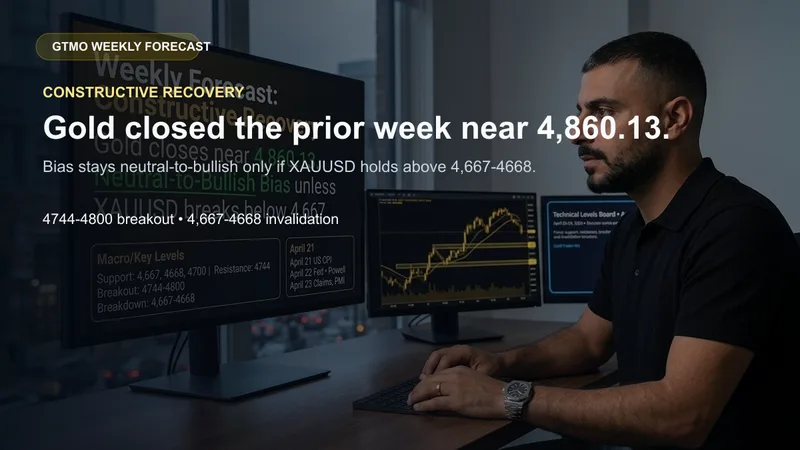
Weekly Gold Forecast Snapshot#
This weekly gold forecast for April 20-24, 2026 starts with 4,860.13 as the key reference and frames US CPI, Fed Chair speech, US Jobless Claims, US PMI, US 10Y auction as the main catalyst cluster that can force gold out of its opening range. The working assumption is not that gold has already chosen its direction, but that the market is entering a high-information week where a small shift in inflation, Fed tone, or yield expectations can reprice the whole metal complex quickly. For traders who search for a weekly gold forecast, the real objective is clarity: what is the base case, which zone matters first, and what evidence would force a bias change.
The immediate value of this snapshot is speed. A reader should be able to understand the opening regime, the first upside decision zone, the main downside invalidation, and the most important catalyst without scrolling through a full recap of the prior month. That is why this section stays thesis-first, level-aware, and event-aware. It is designed to answer the practical search intent behind queries like weekly gold forecast, XAUUSD weekly outlook, and what will drive gold this week.
Where Gold Stands As The Trading Week Gets Underway#
Gold is moving through the opening trading session in a constructive recovery regime. Gold enters April 20-24, 2026 with 17 verified prior-week trade sequences behind it, and the market now needs fresh macro catalysts to decide whether late-week recovery can extend beyond 4744. That starting point matters because a consolidating market is different from a clean trend market. In a trend, traders can focus on continuation quality. In a consolidation, the job is to separate noise from genuine expansion. The closer gold stays to a compressed opening range, the more important it becomes to anchor decisions to catalyst timing instead of projecting momentum too early.
The current backdrop also forces a more disciplined interpretation of price. The dollar closed the prior week near 98.20, so renewed firmness can still cap fast upside. US 10-year yields finished the prior week near 4.25%, so yield pressure remains a first-order constraint. Real-yield pressure and safe-haven demand remain the two forces most likely to reshape gold early in the week. That means the opening regime is not just a chart story. It is a macro-sensitive tape where rate expectations and defensive demand can change the quality of every move. Readers who want continuity can compare this regime to the earlier Weekly Gold Forecast: March 30 - April 3, 2026 | XAUUSD Outlook and the later evidence in Weekly Gold Trading Summary — April 13 – 17, 2026.
The Main Drivers That Could Move Gold This Week#
Gold Trader Mo, the Daily Reports, the gold scalping strategy guide, and Weekly Gold Forecast: March 30 - April 3, 2026 | XAUUSD Outlook provide the broader context. The dollar closed the prior week near 98.20, so renewed firmness can still cap fast upside. US 10-year yields finished the prior week near 4.25%, so yield pressure remains a first-order constraint. The main point is that gold does not move in isolation at the start of a macro-heavy week. If the dollar firms while yields stay elevated, upside continuation usually needs stronger safe-haven demand or a clear macro miss. If yields soften and the dollar loses traction at the same time, gold can move much faster than a purely technical reader expects.
The catalyst map matters because each event can change a different part of the market equation. CPI can reset inflation expectations. Fed communication can reset policy expectations. Geopolitical risk can reset safe-haven demand. That is why a good forecast cannot just list the calendar and stop there. It must explain which event can move yields, which event can move the dollar, and which event can intensify safe-haven demand even if the macro print itself is neutral. When those layers align, gold gets trend fuel. When they conflict, gold often rotates instead of trending.
Another driver that deserves attention is positioning quality. After a compressed opening regime, traders often overreact to the first directional impulse. That can create false breaks above resistance or shallow failures below support. The better framework is to watch whether the market can hold its first expansion with cleaner follow-through, stronger candle closes, and less dependence on a single headline. If it cannot, the base-case rotation remains more credible than an immediate trend call.
Key Technical Levels and Decision Zones#
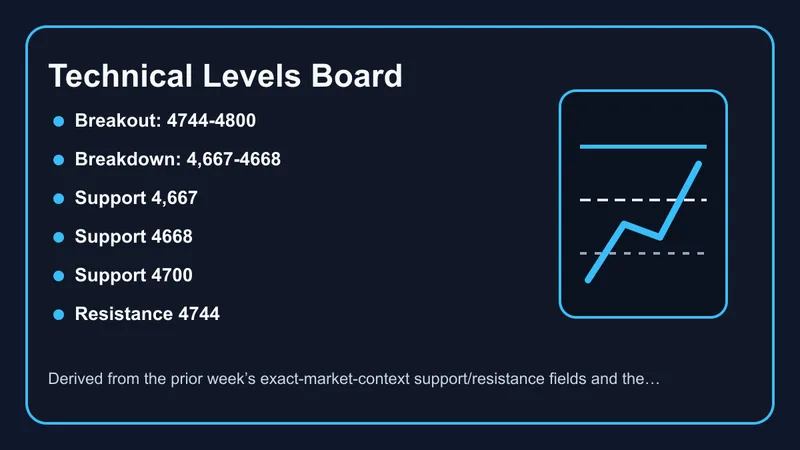
The main upside decision zone is 4744-4800, while 4,667-4668 is the key downside invalidation area. Derived from the prior week’s exact-market-context support/resistance fields and the late-week closing structure. In practical terms, these levels matter because they are where narrative and positioning meet. A break above resistance only matters if it can hold and extend. A break below support only matters if sellers can keep price below the invalidation zone without immediate rejection. That distinction is critical for weekly forecasting because traders are not just looking for levels; they are looking for levels that can change the weekly thesis.
Support and resistance also help define how much patience the market still deserves. If gold continues to bounce cleanly above the lower decision band, the tape is telling readers that dip demand still exists and that downside continuation needs fresh macro confirmation. If price cannot hold those supports, then the market is signaling that the recovery narrative was too weak and that sellers still control the broader tone. The first task is not to predict a number in isolation. The first task is to know which band proves the market is accepting a new direction.
Another reason these zones matter for SEO and utility is that they make the forecast measurable. A reader can return later in the week and judge whether the forecast respected its own logic. That is far more useful than a generic statement that gold may go higher or lower. In this framework, the chart becomes a decision map: where does continuation become credible, where does failure become meaningful, and where does range behavior remain the most likely outcome?
Bullish, Base, and Bearish Scenarios#
Bullish scenario#
Late-week recovery extends if softer yield pressure allows gold to reclaim 4744 and target 4800. The bullish path needs more than a brief headline spike. It needs lower yield pressure, cleaner closes above resistance, and enough follow-through to prove that buyers are not just squeezing shorts for a few hours. If that sequence appears, the week can shift from reactive consolidation into a more constructive recovery narrative, especially if the dollar loses momentum at the same time.
A serious bullish scenario also requires discipline from the reader. The goal is not to assume that the first green candle confirms a new trend. The goal is to watch whether the move survives the next session, whether pullbacks stay shallow, and whether the market keeps accepting higher prices after the main macro catalyst. If those conditions hold, the bullish case becomes a structural read instead of a temporary bounce.
Base scenario#
Gold rotates between 4,667 and 4744 until CPI and Fed tone create a cleaner directional read. This is the most practical scenario for many start-of-week conditions because gold often spends the early sessions compressing information before the strongest macro release arrives. A balanced base case does not mean nothing matters. It means the market has not yet received enough aligned evidence to commit to a cleaner trend.
The value of the base case is that it stops traders from manufacturing conviction too early. In a mixed or consolidating regime, the market often punishes aggressive directional certainty. A range rotation can still be highly tradable, but it requires different behavior: faster confirmation standards, tighter respect for invalidation, and more patience near the edges of the range. That is why the base case is often the most realistic scenario even when readers emotionally prefer a big breakout forecast.
Bearish scenario#
Gold loses its recovery structure if hotter macro data or renewed dollar strength pushes price back through 4,667. The bearish path becomes stronger if inflation stays sticky, yields reprice higher, and the dollar regains control faster than gold can attract safe-haven demand. In that environment, downside breaks matter more because they are being reinforced by macro pressure, not just technical exhaustion. A bearish scenario is strongest when the market no longer treats lower prices as a buying opportunity and instead starts accepting them as a new equilibrium.
What makes the bearish case useful is not fear language. It is conditional clarity. If the downside invalidation breaks and follow-through remains orderly, the weekly thesis must adapt. That is why the bearish scenario is not a doomsday paragraph. It is a measured alternative path that tells the reader exactly what kind of evidence would force a reassessment.
Economic Calendar and Market Risks#
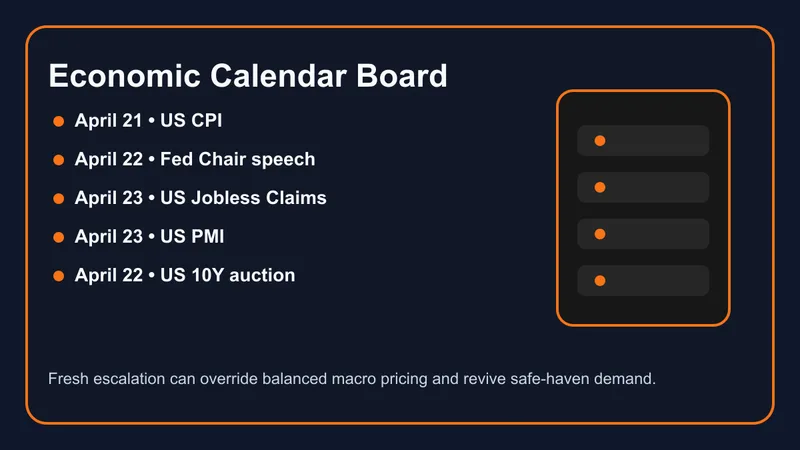
US CPI, Fed Chair speech, US Jobless Claims, US PMI, US 10Y auction matter because CPI, Fed tone, yields, the dollar, and geopolitics can all reprice gold quickly. Readers should treat this section as a catalyst map, not a decorative calendar. A serious weekly forecast must tell the reader why the event matters, what it can change, and how that change would show up in gold. Some events move gold directly through safe-haven demand. Others move gold indirectly by changing real yields or the dollar. Both paths matter.
Risk management also changes around event timing. Early-week price action can be noisy because traders are positioning ahead of information they do not yet have. Midweek data can create false first reactions before the market settles into the more durable interpretation. Late-week follow-through often matters more than the first post-release spike because it shows whether the market actually accepts the new macro narrative. That is why event timing should shape positioning behavior, not just headline awareness.
Geopolitical risk adds another layer of uncertainty. Even when the scheduled calendar looks manageable, an external shock can abruptly change safe-haven demand, oil sensitivity, or dollar behavior. The correct response is not to force geopolitical drama into every forecast. The correct response is to acknowledge where it could materially override the cleaner macro path and to keep scenario flexibility intact.
What Traders Should Watch Day by Day#
Early-week price action should confirm whether gold can hold the opening range. Monday and Tuesday are often about whether the market respects support and whether early upside probes can survive without immediate rejection. Those sessions tell readers whether participants are building conviction or simply waiting for data. If the opening range remains sticky, that increases the odds that the base case remains valid until the first major macro catalyst lands.
Midweek is usually where the weekly forecast gets tested properly. If CPI or a comparable macro catalyst changes the path of yields and the dollar, the technical zones start to matter much more because the macro engine is finally active. That is the point where readers should judge whether the breakout zone is being accepted, whether the downside invalidation is being threatened, and whether the scenario map still holds its internal logic.
Late-week action is about confirmation quality. A move that survives into the final sessions of the week is usually more trustworthy than a move that exists only in the first post-release spike. That is why the day-by-day framework is useful: it helps traders treat the week as a sequence of checkpoints rather than a single emotional bet.
How To Think About Positioning This Week#
Built from prior-week daily packets under /Users/admin/DEV/goldtradermo.net/tmp, exact market context snapshots, and daily signal summaries to preserve continuity without reusing stale fixture packets. The practical takeaway is conditional positioning: wait for confirmation, respect invalidation, and avoid forcing a bias before the macro tape resolves. In a weekly forecast, the most valuable mindset is often not aggression but calibration. The goal is to know what would make the bullish case stronger, what would keep the base case intact, and what would force the bearish case to dominate.
This matters because many readers do not actually need more noise. They need a cleaner decision framework. Positioning should therefore match regime. In a balanced opening regime, smaller assumptions and faster evidence checks are usually superior to large directional commitments. In a confirmed expansion regime, the opposite can be true: the reader can afford to lean more on continuation logic because the market has already proven acceptance.
A second positioning principle is continuity. The weekly forecast should work with the broader GTMO archive, not compete against it. Readers who want live context can use the daily reports to study session-level execution, while the forecast provides the macro map, scenario logic, and higher-level decision zones that tie the week together.
FAQ#
What is the main catalyst for gold this week?#
Inflation data can reset real-yield pressure and quickly reprice gold. In practice, the most important catalyst is the one that can change the relationship between yields, the dollar, and safe-haven demand at the same time. That is why inflation releases and central-bank tone often dominate the weekly narrative.
What is the key downside invalidation zone?#
The key downside invalidation zone remains 4,667-4668 because a decisive break there would weaken the balanced base case. The important nuance is not just the break itself, but whether the market can stay below that zone with orderly follow-through. A failed break is very different from accepted downside continuation.
Connect with Gold Trader Mo#
Use this weekly forecast alongside the daily reports, the market-analysis archive, Weekly Gold Trading Summary — April 13 – 17, 2026, and message @GTMOBest to keep context clean as the week develops.
Disclaimer#
This weekly forecast is for education and commentary only. Trading involves risk, capital can be lost, and past performance never guarantees the next session will look the same.